
By Meera | Jan 8, 2026 |
Small reflections that grow into deeper ways of living.
Look closely at your day.
Not the events.
Not the people.
Not even the outcomes.
Look at the words running quietly in your mind.
As an NLP coach, I often say: “The quality of your life is shaped by the quality of your internal dialogue.”
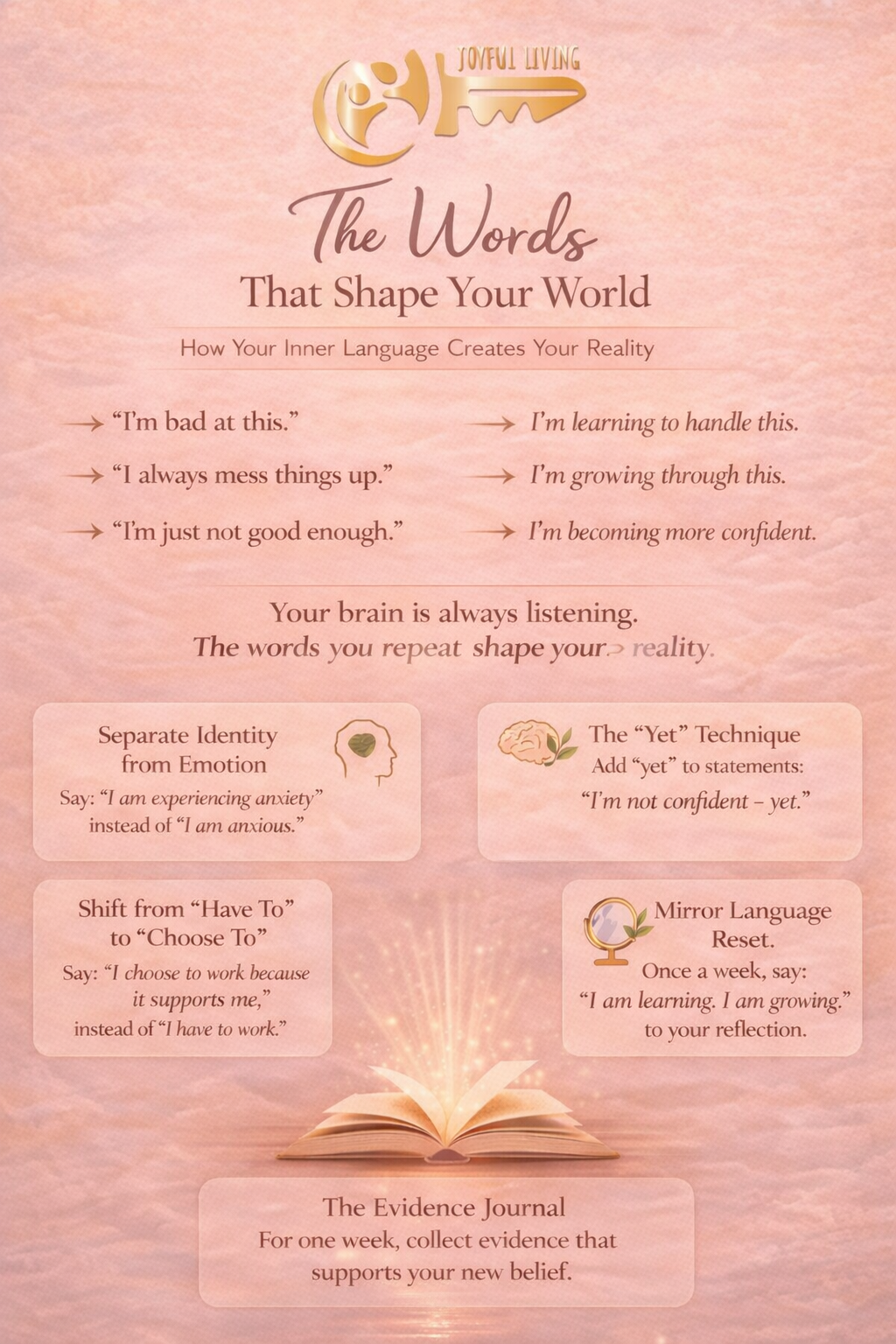
Your brain is always listening and it responds to the language you give it.
Those words may seem small and fleeting, yet they are doing something powerful.
They shape how you interpret what happens, how you feel about it, and how you experience your life.
Often, without realizing it, we are living inside the language we repeat to ourselves.
🌱 Seed of the Week
The words you repeat inside your mind slowly become the world you live in.
🌿 🌿 🌿 🌿 🌿 🌿 🌿 🌿 🌿 🌿 🌿 🌿 🌿 🌿 🌿 🌿 🌿 🌿 🌿 🌿 🌿 🌿 🌿 🌿 🌿 🌿 🌿 🌿 🌿 🌿 🌿 🌿 🌿 🌿 🌿 🌿 🌿 🌿 🌿 🌿 🌿
🧭 The Words That Shape Your World
When you say:
Your nervous system listens. Your body tightens. Your energy drops.
Not because the situation is impossible - but because your language has already decided the meaning.
Your nervous system responds as if it’s true.
But here’s the empowering part:
Language is editable. And the shift begins with one sentence. 🌱
— — — 🌿 — — —— — — 🌿 — — —— — — 🌿 — — —— — — 🌿 — — —— — — 🌿 — — —— — — 🌿 — — —— — — 🌿 — — —— — — 🌿 — — ——
📖 A Story - About One Small Shift
A client once came to me feeling stuck in her career.
Every session, she repeated the same sentence: “I’m just not confident.”
She said it casually. As if it were a fact. Not a belief. Not a pattern. A fact.
When I asked her, “When did you decide that about yourself?” she paused.
She spoke confidently with friends. She managed a team. She handled crises with clarity.
But before presentations, her inner voice whispered: “You’re not confident.”
So we didn’t work on confidence first. We worked on language.
Instead of “I’m not confident,” she practiced saying: “I’m learning to feel more confident in high-visibility situations.”
That was it. No grand breakthrough. No dramatic affirmation. Just one shift.
Within weeks, her body responded differently before meetings.
Less tightening. Less dread. More steadiness.
Nothing outside had changed yet. But her nervous system had stopped receiving the instruction: “You are not capable.”
Language shifted. Identity softened. Behavior followed.
🔍Reflection:
Sometimes the most powerful limitations in our lives are not created by circumstances
They are created by sentences we repeat without questioning.
A small shift in language is the moment when change quietly begins. 🌱
— — — 🌿 — — —— — — 🌿 — — —— — — 🌿 — — —— — — 🌿 — — —— — — 🌿 — — —— — — 🌿 — — —— — — 🌿 — — —— — — 🌿 — — ——
💡 Why Words Shape Reality
The brain is constantly interpreting what happens around us.
Words act like labels that give meaning to our experiences.
When certain phrases repeat frequently in our inner dialogue, the brain begins to treat them as familiar patterns.
If our language often includes:
“I can’t do this.”
“I always fail.”
“Nothing ever works.”
the brain begins expecting those outcomes.
But when our words shift toward:
“I’m learning.”
“This is a challenge.”
“There might be another way.”
our perception expands, and new possibilities become easier to notice.
The situation may remain the same, but the experience changes dramatically.
In subtle ways, the language inside our minds shapes the world we experience.
— — — 🌿 — — —— — — 🌿 — — —— — — 🌿 — — —— — — 🌿 — — —— — — 🌿 — — —— — — 🌿 — — —— — — 🌿 — — —— — — 🌿 — — ——
🎬 Movie & Series Examples
🎬 1. Harry Potter Series – The Power of Naming Fear
Key idea:
“Fear of a name increases fear of the thing itself.”
What it shows:
Most people say “He Who Must Not Be Named” - which strengthens fear.
Harry says “Voldemort” - and faces reality directly.
Insight:
The words we avoid often keep fear alive. Naming truth reduces its power.
🍿 2. Suits (TV Show) – Speaking Identity Into Reality
Key idea:
“I don’t have dreams, I have goals.”
What it shows:
Harvey Specter’s language is precise, decisive, and identity-driven - and it shapes how others see him.
Insight:
The way you speak signals who you believe you are - and others respond accordingly.
🎥 3. Grey’s Anatomy (TV Show) – “Pick Me, Choose Me, Love Me”
Key idea:
Words can reveal - and reinforce - deep emotional patterns.
What it shows:
Meredith’s plea reflects her inner belief about love and worthiness.
Insight:
The words we speak in vulnerable moments often expose the reality we’re living inside.
“The words you repeat don’t just describe your reality - they quietly create it.” 🌱
🌍 Real-Life Situations
You may notice this pattern in everyday life.
At work
“I made a mistake” becomes
“I always mess things up.”
In relationships
“They didn’t reply yet” becomes
“They must be upset with me.”
During challenges
“This is difficult” becomes
“This is impossible.”
Often the emotional weight we feel comes less from the situation itself and more from the meaning we attach to it through language.
Think of someone who says:
“I’m not a morning person.”
They hit snooze.
They move slowly.
They expect low energy.
But someone who says:
“I’m learning to enjoy slow mornings.”
Will start adjusting small behaviors.
Same hour. Different identity. Different experience.
— — — 🌿 — — —— — — 🌿 — — —— — — 🌿 — — —— — — 🌿 — — —— — — 🌿 — — —— — — 🌿 — — —— — — 🌿 — — —— — — 🌿 — — ——
💬 Quotes That Reflect This Truth
-“Whether you think you can, or you think you can’t - you’re right.”
- Henry Ford
“The limits of my language mean the limits of my world.”
- Ludwig Wittgenstein
“Words are, of course, the most powerful drug used by mankind.”
- Rudyard Kipling
🛠️ NLP Technique — The Language Shift
Changing your reality does not require forced positivity. It requires more conscious language.
1. Separate Identity from Emotion
Instead of saying:
“I am anxious.”
“I am bad at this.”
“I am terrible with money.”
Say:
“I am experiencing anxiety.”
“I am still learning this.”
“I am building better money habits.”
This separates identity from emotion.
🌿You are not the state. You are experiencing the state. That shift alone reduces emotional intensity.
2. The “Yet” Technique
When you catch yourself saying:
“I’m not confident.”
“I don’t understand this.”
Add one gentle word: “Yet.”
“I’m not confident yet.”
“I don’t understand this yet.”
🌿That one word opens the door to growth. The brain shifts from finality to possibility.
3. Shift from “Have To” to “Choose To”
Notice how your body feels when you say:
“I have to wake up early.”
“I have to go to work.”
“I have to handle this.”
There’s a heaviness in it. It feels like pressure. Obligation. Force.
Now gently say:
“I choose to wake up early because it supports my goals.”
“I choose to work because it provides for me.”
“I choose to handle this because it matters.”
The task hasn’t changed. But your experience of it has.
When something feels forced, it feels heavy, your mind resists.
When something feels chosen, it feels empowering, your mind cooperates.
🌿Pressure softens when choice appears.
4. Mirror Language Reset
Once a week, stand in front of a mirror and say:
“I am learning.”
“I am growing.”
“I am becoming.”
🌿Not forced affirmations. Gentle identity shaping.
5. The Evidence Journal
If you keep repeating a limiting sentence, your brain will look for proof to support it. So give it new proof.
For one week, collect evidence that contradicts your limiting sentence.
If your sentence is: “I’m not disciplined.” Write down:
The day you woke up early.
The habit you maintained.
The task you completed.
The promise you kept.
🌿The brain believes repetition. With new evidence, you gently teach it a new story.
— — — 🌿 — — —— — — 🌿 — — —— — — 🌿 — — —— — — 🌿 — — —— — — 🌿 — — —— — — 🌿 — — —— — — 🌿 — — —— — — 🌿 — — ——
💛 The Joy Connection
Joy is not simply the result of perfect circumstances.
Often it grows from the meaning we give to what happens.
When our inner language becomes more compassionate and open, life begins to feel lighter.
The world outside may remain the same.
But our experience of it begins to change.
— — — 🌿 — — —— — — 🌿 — — —— — — 🌿 — — —— — — 🌿 — — —— — — 🌿 — — —— — — 🌿 — — —— — — 🌿 — — —— — — 🌿 — — ——
🧠 NLP Insight
In Neuro-Linguistic Programming, language is one of the most powerful tools shaping human experience.
The words we use internally influence the mental pictures we create, the emotions we feel, and the actions we take.
When language changes, our interpretation of events changes.
And when interpretation changes, behavior often changes as well.
This is why small shifts in internal language can create significant shifts in perception and possibility.

🧠 Neuroscience Insight
Neuroscience shows that the brain does not clearly distinguish between vividly imagined language and lived experience.
When you repeatedly tell yourself, “I’m not capable”, the brain begins activating neural pathways associated with threat and self-protection. The amygdala becomes more alert, cortisol levels rise, and the body subtly prepares for failure or withdrawal.
Research in neuroplasticity demonstrates that the brain continuously rewires itself based on repeated thoughts and experiences. What we repeat strengthens.
When you shift to growth-based language such as “I’m learning” or “I’m building this skill”, you engage the prefrontal cortex - the part of the brain responsible for regulation, perspective, and problem-solving.
Over time, the language you repeat strengthens the neural pathways connected to it.
This is neuroplasticity in action: the brain reorganizing itself based on the words and meanings you consistently feed it.
In other words, the sentences you practice inside your mind slowly become the patterns your brain learns to follow.
— — — 🌿 — — —— — — 🌿 — — —— — — 🌿 — — —— — — 🌿 — — —— — — 🌿 — — —— — — 🌿 — — —— — — 🌿 — — —— — — 🌿 — — ——
🪞 Reflection for This Week
Take a moment to ask yourself:
• What words do I most often use when describing my life?
• Are those words expanding my perspective or limiting it?
• What new sentence would I like to practice this week?
Every sentence you repeat is either reinforcing who you were - or rehearsing who you are becoming.
Sometimes the smallest shift in language can quietly open the door to an entirely new way of seeing.
📝 Practice for the Week
For the next seven days, gently notice the words you use when something challenging happens.
When you catch yourself saying:
“I can’t do this.”
“This is impossible.”
“This always happens to me.”
Pause and ask:
“Is there another way I could describe this situation?”
Then try replacing the sentence with a more open one:
“I’m still figuring this out.”
“This is challenging, but I can take one step.”
“Maybe there’s another way.”
You do not need forced optimism. Simply choose words that keep possibility alive.
Observe how this small shift influences your emotional response.
✨This week’s seed is simple: The words you repeat inside your mind slowly become the world you live in.🌱
🌿 🌿 🌿 🌿 🌿 🌿 🌿 🌿 🌿 🌿 🌿 🌿 🌿 🌿 🌿 🌿 🌿 🌿 🌿 🌿 🌿 🌿 🌿 🌿 🌿 🌿 🌿 🌿 🌿 🌿 🌿 🌿 🌿 🌿 🌿 🌿 🌿 🌿 🌿 🌿 🌿
🌱 Every thought plants a seed. Choose the ones that grow into joy.
Enjoy every moment of your life, Live Joyfully :)
✨ Choose consciously. Live joyfully. Become who you’re meant to be.
Pause for a moment & Share
Sometimes it’s the smallest decisions that can change your life forever.
✨ Choose consciously. Live joyfully. Become who you’re meant to be.
©2023 All Rights Reserved