
By Meera | Feb 19, 2026 |
Small reflections that grow into deeper ways of living.
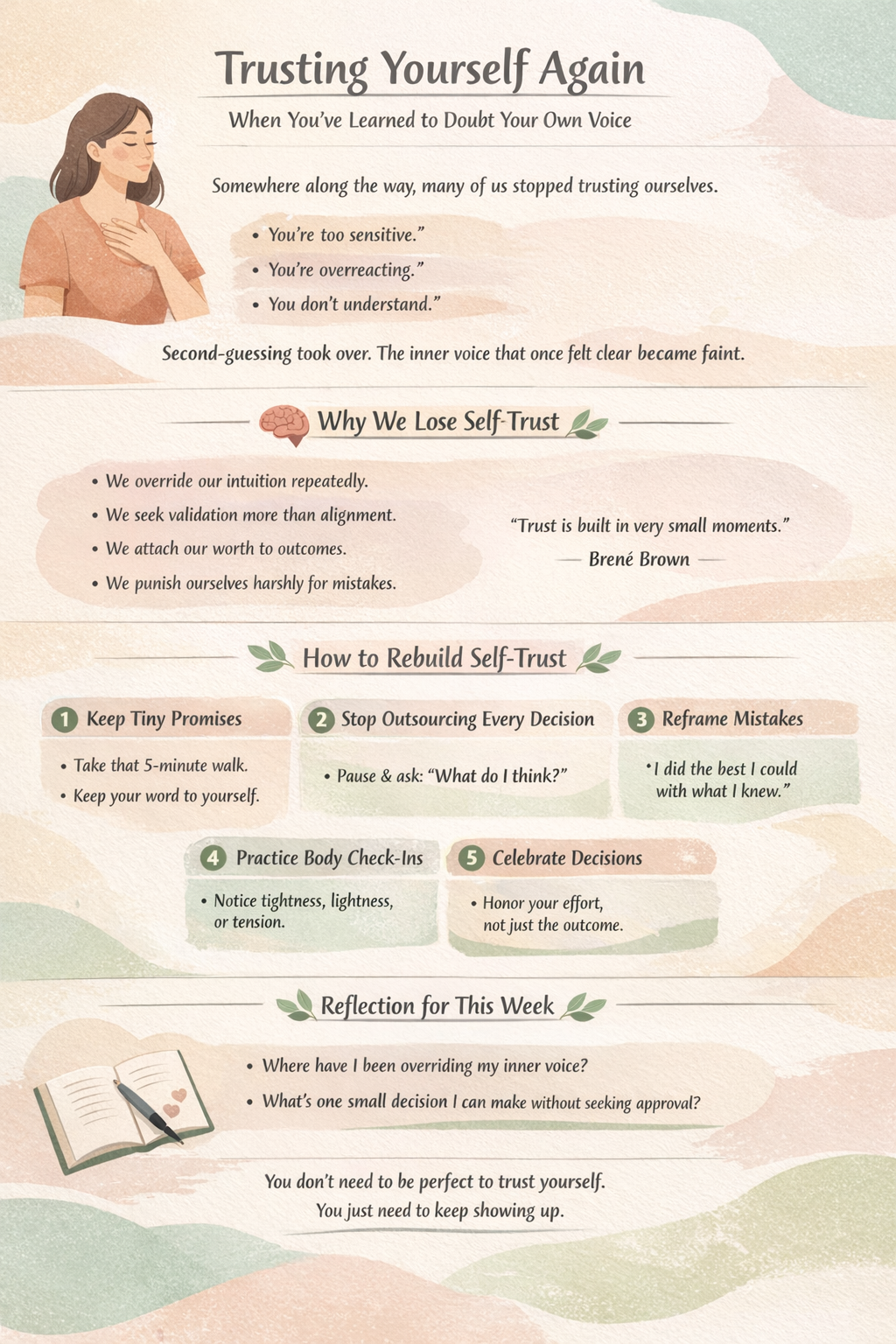
Somewhere along the way, many of us stopped trusting ourselves.
Maybe we were told:
• “You’re too sensitive.”
• “You’re overreacting.”
• “You don’t understand.”
Maybe a decision didn’t work out.
Maybe we were judged.
Maybe we disappointed ourselves.
And slowly, quietly, a new habit formed:
Second-guessing.
We began asking everyone else what they think.
We delayed decisions.
We doubted our instincts.
The inner voice that once felt clear became faint.
But the ability to trust yourself is not something you lose forever.
Like many inner qualities, it can be remembered, rebuilt, and strengthened over time.
🌱 Seed of the Week
Self-trust grows each time you listen to your inner voice and act on it.
🌿 🌿 🌿 🌿 🌿 🌿 🌿 🌿 🌿 🌿 🌿 🌿 🌿 🌿 🌿 🌿 🌿 🌿 🌿 🌿 🌿 🌿 🌿 🌿 🌿 🌿 🌿 🌿 🌿 🌿 🌿 🌿 🌿 🌿 🌿 🌿 🌿 🌿 🌿 🌿 🌿
🧭 Trusting Yourself Again - When You’ve Learned to Doubt Your Own Voice
Self-trust is the quiet confidence that you can listen to your own inner guidance.
It doesn’t mean always having perfect answers.
It means believing that even when things are uncertain, you can navigate your way forward.
When self-trust weakens, we may begin to second-guess ourselves constantly:
“Maybe I’m wrong.”
“What if I make the wrong choice?”
“I should ask someone else first.”
Over time, this habit can make us feel disconnected from our own intuition.
Rebuilding self-trust begins with learning to listen inward again.
— — — 🌿 — — —— — — 🌿 — — —— — — 🌿 — — —— — — 🌿 — — —— — — 🌿 — — —— — — 🌿 — — —— — — 🌿 — — —— — — 🌿 — — ——
📖 A Story - The Hiker Who Almost Turned Back
Riya had been planning this solo trek for months.
It wasn’t just about the mountains.
It was about proving something to herself.
That she could do things alone.
That she could trust herself.
On the second day, the trail split into two paths.
One was clearly marked. Safe. Frequently used.
The other was quieter. Narrow. Less certain.
She checked her map.
Both led to the same destination.
Almost instantly, doubt crept in.
“What if I get lost?”
“What if this is the wrong choice?”
“Maybe I should just take the safe route…”
She pulled out her phone.
No signal.
No one to ask.
No reassurance coming.
And for a moment - that felt terrifying.
But then something shifted.
She stood still.
Closed her eyes.
And noticed.
The busy path felt rushed. Noisy. Heavy.
The quieter one felt calm.
Not easy… but right.
There was no dramatic sign.
No certainty.
Just a quiet sense of: “This way.”
Her mind argued.
Her body knew.
So she chose the quieter path.
The walk wasn’t perfect.
There were moments she questioned herself again.
Moments of: “Did I make a mistake?”
But every time doubt came up, she didn’t panic.
She checked in again.
Listened again.
And step by step…
She reached the top.
Not because she picked the “perfect” path.
But because she stayed connected to herself along the way.
At the summit, something felt different.
It wasn’t pride in the hike.
It was quieter than that.
She trusted herself a little more.
🔍
Self-trust isn’t about always choosing the “right” path.
It’s about: Not abandoning yourself
after you choose.🌱
— — — 🌿 — — —— — — 🌿 — — —— — — 🌿 — — —— — — 🌿 — — —— — — 🌿 — — —— — — 🌿 — — —— — — 🌿 — — —— — — 🌿 — — ——
💡 Why Self-Trust Matters
Self-trust shapes how we move through uncertainty.
When we trust ourselves, decisions feel less overwhelming.
We may still seek advice or information, but we remain connected to our own sense of direction.
Without self-trust, we can become dependent on external validation.
We may delay decisions, worry excessively about mistakes, or doubt our instincts.
Rebuilding self-trust allows us to move forward with greater clarity and inner steadiness.
Self-trust erodes when:
• We override our intuition repeatedly
• We seek validation more than alignment
• We attach our worth to outcomes
• We punish ourselves harshly for mistakes
But here’s the truth:
Trust isn’t built by being perfect.
It’s built by showing up for yourself consistently.
As Brené Brown says:
“Trust is built in very small moments.”
Including the moments
you keep promises to yourself.
“Trust yourself. You know more than you think you do.” - Benjamin Spock
— — — 🌿 — — —— — — 🌿 — — —— — — 🌿 — — —— — — 🌿 — — —— — — 🌿 — — —— — — 🌿 — — —— — — 🌿 — — —— — — 🌿 — — ——
🎬 Movie & Series Examples
🎥 1. Moana – Coming Back to Her Inner Call
What breaks trust:
Doubt, fear, and losing her way.
Turning point: “I am Moana.”
What changes: She stops seeking external validation and listens to her inner knowing.
Insight:
Trust returns when you remember who you are beneath the noise.
🎬 2. The Matrix – Trusting Inner Knowing Over Doubt
What breaks trust:
External doubt, uncertainty, disbelief.
Turning point: Neo chooses to trust his inner knowing.
What changes: He moves from hesitation → certainty.
Insight:
At some point, you stop asking and start knowing.
🍿 3. Grey’s Anatomy (TV) – Owning Your Decisions
What breaks trust:
Comparison, fear of getting it wrong.
Turning point: Making choices and standing by them.
What changes: Confidence grows through action.
Insight:
Self-trust is built by keeping promises to yourself.
🎬 4. Brave – Listening to Your Own Path
What breaks trust:
Pressure to conform and follow expectations.
Turning point: Merida chooses her own path.
What changes: She aligns with her truth instead of external approval.
Insight:
Trusting yourself often means disappointing expectations.
“Self-trust isn’t about always being right - it’s about staying connected to yourself, no matter what.” 🌱
🌍 Real-Life Situations
Self-trust appears in everyday moments.
Choosing a direction in your career.
Setting boundaries in relationships.
Trying something new even when you feel uncertain.
Sometimes the challenge is not a lack of knowledge.
It is the quiet belief that your inner voice deserves to be heard.
The more we listen to it, the clearer it becomes.
— — — 🌿 — — —— — — 🌿 — — —— — — 🌿 — — —— — — 🌿 — — —— — — 🌿 — — —— — — 🌿 — — —— — — 🌿 — — —— — — 🌿 — — ——
💬 Quotes That Reflect This Truth
“The privilege of a lifetime is to become who you truly are.” - Carl Jung
“You yourself, as much as anybody in the entire universe, deserve your love and affection.” - Gautama Buddha
“The more you trust yourself, the less you need approval.”
“Self-trust is the foundation of inner peace.”
🛠️ How to Rebuild Self-Trust
Self-trust grows through small, consistent experiences.
1. Start With Small Decisions
Practice trusting yourself in everyday choices.
What to prioritize today.
What feels right for your energy.
1a. Stop Outsourcing Every Decision
Before asking someone else: Pause.
Ask yourself first: “What do I think?”
Even if you later seek advice,
consult yourself first.
Small decisions strengthen confidence.
2. Listen to Your Inner Signals
Your body and emotions often provide subtle signals.
Pay attention to feelings of ease, tension, curiosity, or resistance.
Your intuition often shows up physically. Notice:
• Tightness
• Lightness
• Expansion
• Resistance
The body whispers before the mind understands.
These signals can guide your awareness.
3. Accept That Mistakes Are Part of Learning
Self-trust does not require perfect decisions.
It grows when we allow ourselves to learn from experience.
3b. Reframe Mistakes
Instead of: “I messed up. I can’t trust myself.”
Say: “I made the best decision I could
with what I knew.”
Trust grows when self-punishment softens.
Every decision teaches something valuable.
4. Keep the Promises You Make to Yourself
Even small commitments matter.
If you say you'll take a 5-minute walk - take it.
If you decide to sleep earlier - do it.
Small integrity builds internal safety.
When you follow through on intentions you set for yourself, your brain begins to register:
“I can rely on myself.”
5. Celebrate Decisions - Not Just Outcomes
Even if the outcome isn’t perfect,
honor the courage it took to choose.
Trust grows when you respect your own effort.
— — — 🌿 — — —— — — 🌿 — — —— — — 🌿 — — —— — — 🌿 — — —— — — 🌿 — — —— — — 🌿 — — —— — — 🌿 — — —— — — 🌿 — — ——
💛 The Joy Connection
Joy often grows in environments of trust.
When we trust ourselves, life begins to feel less like a constant test and more like a journey of discovery.
We move with greater ease because we no longer feel the need to control every outcome.
Instead, we begin trusting that we can respond to whatever life brings.
And in that space, a quiet sense of freedom begins to emerge.
— — — 🌿 — — —— — — 🌿 — — —— — — 🌿 — — —— — — 🌿 — — —— — — 🌿 — — —— — — 🌿 — — —— — — 🌿 — — —— — — 🌿 — — ——
🧠 NLP Insight
In Neuro-Linguistic Programming, self-trust is closely connected to the way we interpret our experiences and the internal language we use when making decisions.
Many people weaken their self-trust through global self-judgments, such as:
“I always make the wrong decisions.”
“I’m not good at trusting my instincts.”
In NLP, these statements are called generalizations.
When repeated often, they create a mental filter that causes the mind to notice evidence that confirms the belief.
One way to rebuild self-trust is to challenge these generalizations and shift toward more accurate language.
For example:
“I always make the wrong decisions.” can become
“Some decisions didn’t work out, but I’ve also made many good ones.”
This shift allows the mind to see a fuller picture of experience.
Another NLP principle that supports self-trust is state awareness.
Our ability to trust ourselves often changes depending on our emotional state.
When we feel calm and centered, our thinking becomes clearer and more intuitive.
When we feel anxious or pressured, doubt tends to increase.
Practices that help regulate emotional states - such as pausing, breathing, or stepping back from immediate pressure -
can help reconnect us with our internal guidance.
Over time, self-trust grows through repeated experiences of listening to ourselves, making decisions, and learning from the outcomes.
In this way, self-trust is not something we either have or lack.
It is something we gradually strengthen through awareness, language, and experience.

🧠 Neuroscience Insight
Self-trust is closely connected to how the brain processes uncertainty and decision-making.
When we constantly doubt our choices, the brain’s threat-detection systems can become more active,
increasing anxiety and hesitation.
However, when we repeatedly make decisions and observe their outcomes,
the brain begins forming stronger neural pathways related to confidence and self-efficacy.
The prefrontal cortex, responsible for planning and evaluation, becomes more engaged
as we practice making decisions and reflecting on the results.
Through neuroplasticity, these repeated experiences gradually strengthen the brain’s ability to trust its own judgments.
Over time, self-trust becomes not just a feeling, but a learned pattern of thinking and acting.
— — — 🌿 — — —— — — 🌿 — — —— — — 🌿 — — —— — — 🌿 — — —— — — 🌿 — — —— — — 🌿 — — —— — — 🌿 — — —— — — 🌿 — — ——
🪞 Reflection for This Week
Take a moment to ask yourself:
• In what areas of my life do I trust myself most?
• Where do I tend to doubt my own judgment?
• What small decision could I practice trusting myself with today?
You do not need to be flawless to trust yourself.
You only need to keep showing up. And each time you do,
your inner voice grows stronger.
Sometimes rebuilding self-trust begins with one small choice.
📝 Practice for the Week
For the next seven days, pause before seeking external validation.
When faced with a decision, ask yourself: “What feels right to me in this moment?”
Listen quietly.
Then take a small step based on that answer.
Each time you do this, you strengthen the quiet belief that your inner voice is worth trusting.
✨This week’s seed is simple: Self-trust grows each time you listen to your inner voice and act on it. 🌱
🌿 🌿 🌿 🌿 🌿 🌿 🌿 🌿 🌿 🌿 🌿 🌿 🌿 🌿 🌿 🌿 🌿 🌿 🌿 🌿 🌿 🌿 🌿 🌿 🌿 🌿 🌿 🌿 🌿 🌿 🌿 🌿 🌿 🌿 🌿 🌿 🌿 🌿 🌿 🌿 🌿
🌱 Every thought plants a seed. Choose the ones that grow into joy.
Enjoy every moment of your life, Live Joyfully :)
✨ Choose consciously. Live joyfully. Become who you’re meant to be.
Pause for a moment & Share
Sometimes it’s the smallest decisions that can change your life forever.
✨ Choose consciously. Live joyfully. Become who you’re meant to be.
©2023 All Rights Reserved