
By Meera | Jan 22, 2026 |
Small reflections that grow into deeper ways of living.
Have you ever reacted strongly…
and later wondered,
“Why did that affect me so much?”
A comment.
A tone.
A delay in response.
A look on someone’s face.
And suddenly your body tightens.
Your mood shifts.
Your mind creates a story.
That’s not weakness.
That’s a trigger.
And triggers are not random.
They are stored meanings from past experiences.
🌱 Seed of the Week
Emotional triggers reveal old meanings our mind has carried into the present.
When we change the meaning behind a trigger, our response begins to change as well.
🌿 🌿 🌿 🌿 🌿 🌿 🌿 🌿 🌿 🌿 🌿 🌿 🌿 🌿 🌿 🌿 🌿 🌿 🌿 🌿 🌿 🌿 🌿 🌿 🌿 🌿 🌿 🌿 🌿 🌿 🌿 🌿 🌿 🌿 🌿 🌿 🌿 🌿 🌿 🌿 🌿
🧭 Rewriting Emotional Triggers
Emotional triggers are moments when something small in the present creates a strong reaction within us.
These reactions are not just about what is happening now -
they are often shaped by past experiences, learned meanings, and emotional memory.
Rewriting emotional triggers means learning to pause, observe, and gently shift your response, instead of reacting automatically.
It’s not about removing triggers, but about changing your relationship with them.
For example, imagine someone at work says,
“We need to talk about your report.”
One person might think: “Okay, maybe they want to improve something.”
Another person might immediately feel anxious and think: “I’ve done something wrong.”
The situation is the same.
But the meaning attached to it is different.
If someone has previously experienced harsh criticism, their mind may automatically interpret feedback as failure.
Rewriting the trigger means recognizing that automatic interpretation and gently reframing it.
Instead of thinking: “I’m being criticized because I’m not good enough.”
They might shift to: “This is feedback that can help me improve.”
The event doesn’t change.
But the meaning changes - and with it, the emotional response.
Over time, these small shifts help us respond with more calm, clarity, and confidence.
A trigger is not just about the present moment - it is the past asking to be seen with awareness. 🌱
— — — 🌿 — — —— — — 🌿 — — —— — — 🌿 — — —— — — 🌿 — — —— — — 🌿 — — —— — — 🌿 — — —— — — 🌿 — — —— — — 🌿 — — ——
📖 A Story
A client once shared that she felt deeply upset whenever her colleague interrupted her during meetings.
Each time it happened, she felt ignored and disrespected.
Her frustration built quickly, and she often remained silent for the rest of the discussion.
When we explored it further, she realized that the feeling was familiar.
Growing up, she often felt her opinions were dismissed in family conversations.
Interruptions had come to mean, “Your voice doesn’t matter.”
So when it happened at work, her mind didn’t just interpret the interruption as a workplace behavior.
It triggered an older emotional meaning.
Once she recognized this pattern, she began reframing it.
Instead of thinking, “They don’t respect me,” she practiced thinking,
“People sometimes interrupt in fast conversations. I can calmly continue my point.”
That shift changed her response.
Instead of withdrawing, she would say gently, “Let me finish my thought.”
Over time, the emotional intensity faded.
The trigger lost its power because the meaning behind it had changed.
🔍
Not every strong reaction belongs to the present moment.
Sometimes it is an old story asking to be rewritten.
Pause. Breathe.
Choose a new meaning.
And watch how your response begins to change. 🌱
— — — 🌿 — — —— — — 🌿 — — —— — — 🌿 — — —— — — 🌿 — — —— — — 🌿 — — —— — — 🌿 — — —— — — 🌿 — — —— — — 🌿 — — ——
💡 Why Triggers Matter
When emotional triggers go unnoticed, they can quietly shape how we feel, react, and relate to others.
Small moments can feel overwhelming, not because of what is happening now,
but because of the meaning our mind has attached to similar experiences in the past.
But when we begin to notice our triggers with awareness, something shifts.
We create space between what happens and how we respond.
In that space, we are no longer driven by automatic reactions.
We begin to respond with greater clarity, calm, and choice.
Over time, this awareness softens old patterns and allows us to experience situations more as they are -
rather than through the lens of the past.
And in that gentle shift, we move from reacting unconsciously
to responding with understanding.
This awareness allows us to create healthier emotional patterns and more balanced relationships.
— — — 🌿 — — —— — — 🌿 — — —— — — 🌿 — — —— — — 🌿 — — —— — — 🌿 — — —— — — 🌿 — — —— — — 🌿 — — —— — — 🌿 — — ——
🎬 Movie & Series Examples
🎥 1. Good Will Hunting – Healing the Trigger of Worthlessness
The trigger:
Intimacy → triggers shame and self-sabotage.
Old reaction:
Push people away, act defensive.
Rewrite moment:
“It’s not your fault.”
What changes:
Will begins to feel instead of defend.
Insight:
When the meaning behind a trigger changes, the reaction softens.
🍿 2. Inside Out – Rewriting the Fear of Sadness
The trigger:
Sadness → seen as something to avoid.
Old reaction:
Suppress, distract, stay “happy.”
Rewrite moment:
Sadness becomes the bridge to connection.
What changes:
Riley reconnects with her parents and feels supported.
Insight:
Triggers aren’t problems - they’re signals asking for a different response.
🎬 3. The Office (TV) – From Reactivity to Awareness
The trigger:
Rejection or not being liked.
Old reaction:
Overcompensate, seek approval, create chaos.
Rewrite moment:
Michael slowly develops self-awareness and pauses before reacting.
What changes:
His relationships become more genuine.
Insight:
Awareness is the first step to rewriting any emotional pattern.
“A trigger is not your enemy - it’s an invitation to respond in a new way.” 🌱
🌍 Real-Life Situations
Emotional triggers appear in everyday moments:
• A delayed text reply may feel like rejection.
• Feedback from a manager may feel like personal criticism.
• Someone raising their voice may immediately feel like conflict.
In many cases, the reaction is influenced not just by the present situation,
but by past experiences our mind has linked to similar moments.
When we pause and examine the meaning we are attaching, we create space for a new response.
— — — 🌿 — — —— — — 🌿 — — —— — — 🌿 — — —— — — 🌿 — — —— — — 🌿 — — —— — — 🌿 — — —— — — 🌿 — — —— — — 🌿 — — ——
💬 Quotes That Reflect This Truth
“Between stimulus and response there is a space. In that space is our power to choose our response.”
- Viktor Frankl
“Every trigger carries a story from the past - awareness helps you write a new one.”
“Your reaction is learned - but your response can be chosen.”
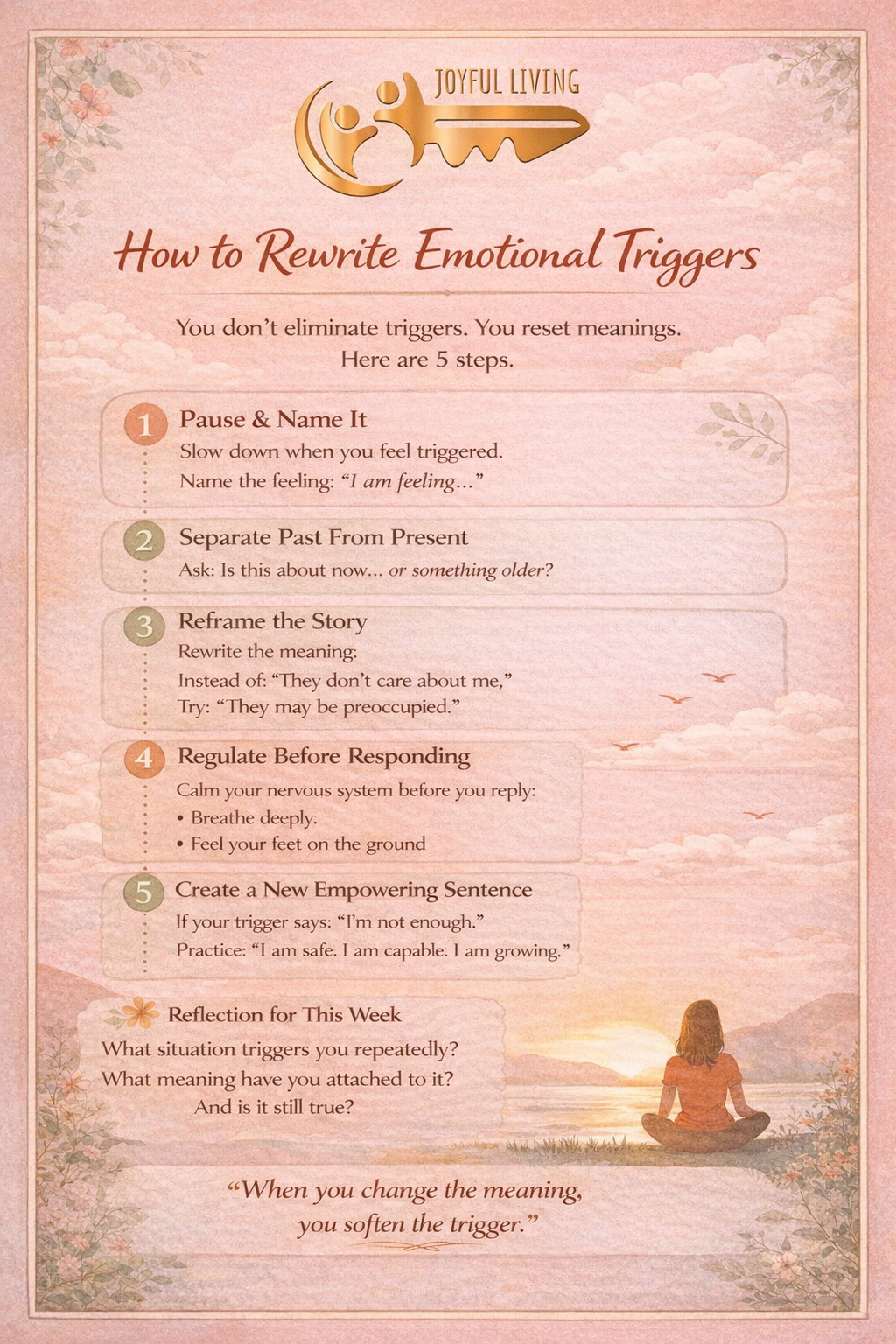
🛠️ How to Gently Rewrite Emotional Triggers
You don’t eliminate triggers.
You update the meaning attached to them.
1. Pause & Name the Trigger
Instead of reacting immediately, ask:
“What am I actually feeling?”
Hurt? Rejection? Shame? Fear?
Naming reduces intensity.
2. Separate Past from Present
Ask:
“Is this reaction about now… or something older?”
Sometimes the body is responding to a memory, not the moment.
3. Reframe the Meaning
Instead of: “They ignored me.”
Say: “They may be preoccupied.”
Instead of: “I’m being criticized.”
Say: “This is feedback, not rejection.”
You’re not denying emotion.
You’re widening interpretation.
4. Regulate Before You Respond
Triggers live in the nervous system.
Before responding: Slow your breathing.
Place your feet firmly on the ground.
Take one long exhale.
Safety first. Logic second.
5. Create a New Empowering Sentence
If your trigger says: “I’m not enough.”
Practice: “I am safe. I am capable. I am growing.”
Repetition builds a new emotional pathway.
— — — 🌿 — — —— — — 🌿 — — —— — — 🌿 — — —— — — 🌿 — — —— — — 🌿 — — —— — — 🌿 — — —— — — 🌿 — — —— — — 🌿 — — ——
💛 The Joy Connection
Joy is not the absence of triggers.
It is the ability to respond consciously.
When emotional triggers control our reactions, we often feel stuck in patterns of anger, hurt, or defensiveness.
But when we begin to notice those triggers and gently rewrite the meaning behind them, something powerful happens.
We create space.
Space between the moment and our reaction.
Space to breathe.
Space to choose.
And in that space, we often discover a sense of calm and self-trust that wasn’t there before.
Over time, situations that once felt overwhelming begin to feel more manageable.
The emotional charge softens, and we move through life with greater ease.
That ease is where joy quietly grows.
Not because the world has changed,
but because our relationship with our experiences has changed.
— — — 🌿 — — —— — — 🌿 — — —— — — 🌿 — — —— — — 🌿 — — —— — — 🌿 — — —— — — 🌿 — — —— — — 🌿 — — —— — — 🌿 — — ——
🧠 NLP Insight
In Neuro-Linguistic Programming, emotional triggers are understood as learned associations
between an external stimulus and an internal emotional state. NLP calls this process anchoring.
An anchor forms when a strong emotional experience becomes linked to a particular cue -
such as a word, tone of voice, facial expression, or situation. Once the brain creates this connection, the cue can automatically activate the same emotional response again and again.
For example, if someone experienced criticism in the past and felt shame or rejection, even mild feedback later in life
may trigger the same emotional reaction.
The mind is not responding to the present moment alone - it is responding to a stored emotional pattern.
From an NLP perspective, the goal is not to eliminate triggers but
to change the internal meaning and emotional state associated with them.
When you pause, observe the trigger, and consciously choose a different interpretation,
you begin to weaken the old association and create a new one.
Over time, the brain learns that the same situation can produce a different emotional response.
In simple terms:
Trigger → Awareness → New Meaning → New State
What once automatically produced anxiety or defensiveness can gradually lead to calm, curiosity, or confidence.
Rewriting emotional triggers is essentially updating the emotional “program” your mind has been running.
And with consistent practice, you begin to respond to situations with greater choice, flexibility, and emotional freedom.

🧠 Neuroscience Insight
When something triggers a strong emotional reaction, it’s not simply about the present moment.
Often, the brain is responding to a stored emotional memory.
A small almond-shaped structure in the brain called the amygdala acts as the brain’s threat detector.
Its role is to quickly scan situations for anything that resembles past danger or emotional pain.
If it senses a familiar pattern - a tone of voice, a facial expression, or a certain situation - it activates a stress response almost instantly.
This reaction happens faster than the rational part of the brain can process what’s actually happening.
That’s why emotional triggers often feel immediate and intense.
However, the brain is capable of change through a process called neuroplasticity.
When you pause, regulate your breathing, and consciously reinterpret the meaning of a situation,
the prefrontal cortex - the brain’s decision-making and reasoning center - becomes more active.
It helps calm the amygdala and reassess the situation more accurately.
With repeated practice, the brain begins to create new neural pathways.
The old automatic reaction becomes weaker, and a calmer response becomes more natural.
In other words, every time you respond with awareness instead of reacting automatically,
You are helping your brain learn a new emotional pattern.
Over time, situations that once triggered stress or defensiveness can begin to feel more neutral - even manageable.
Rewriting emotional triggers is not about ignoring emotions.
It is about teaching the brain that the present moment is different from the past.
And each time you do that, your brain becomes a little more flexible, resilient, and calm.
— — — 🌿 — — —— — — 🌿 — — —— — — 🌿 — — —— — — 🌿 — — —— — — 🌿 — — —— — — 🌿 — — —— — — 🌿 — — —— — — 🌿 — — ——
🪞 Reflection for This Week
Take a quiet moment and think about a recent situation that triggered a strong emotional reaction.
Ask yourself:
What exactly triggered my reaction?
Was it a word, a tone, a situation, or a memory?
What meaning did my mind attach to that moment?
Did I interpret it as rejection, criticism, or being unimportant?
Is there another possible meaning for what happened?
How would I like to respond the next time a similar situation occurs?
Remember, the goal is not to judge your reaction, but to understand the pattern behind it.
Awareness is the first step to rewriting it.
📝 Practice for the Week
This week, choose one situation that tends to trigger a strong emotional reaction.
Pause gently
Name the feeling: “I notice I am feeling…”
Take a slow breath
Ask: “Is this about now, or something older?”
This simple awareness creates space between you and the reaction.
✨This week’s seed is simple: Not every strong reaction belongs to the present moment.
Sometimes it is an old story asking to be rewritten.
“When you bring awareness to a reaction, you begin to rewrite the story behind it.”
🌿 🌿 🌿 🌿 🌿 🌿 🌿 🌿 🌿 🌿 🌿 🌿 🌿 🌿 🌿 🌿 🌿 🌿 🌿 🌿 🌿 🌿 🌿 🌿 🌿 🌿 🌿 🌿 🌿 🌿 🌿 🌿 🌿 🌿 🌿 🌿 🌿 🌿 🌿 🌿 🌿
🌱 Every thought plants a seed. Choose the ones that grow into joy.
Enjoy every moment of your life, Live Joyfully :)
✨ Choose consciously. Live joyfully. Become who you’re meant to be.
Pause for a moment & Share
Sometimes it’s the smallest decisions that can change your life forever.
✨ Choose consciously. Live joyfully. Become who you’re meant to be.
©2023 All Rights Reserved