
By Meera | Nov 17, 2025 |
Small reflections that grow into deeper ways of living.
Pause for a moment and notice what is happening in your mind right now.
Perhaps a thought about today.
Perhaps something you need to do later.
Perhaps a quiet commentary about what you are reading.
Now gently ask yourself:
Did you create that thought intentionally, or did it simply appear?
Most of the time, thoughts arise on their own.
And the moment you notice a thought appearing, something interesting becomes clear -
there is a part of you that is aware of it.
This week’s seed invites you to explore that quiet but powerful realization:
You are not your thoughts. You are the one noticing them. 🌱
🌱 Seed of the Week
If you can observe a thought, it cannot be who you are.
🌿 🌿 🌿 🌿 🌿 🌿 🌿 🌿 🌿 🌿 🌿 🌿 🌿 🌿 🌿 🌿 🌿 🌿 🌿 🌿 🌿 🌿 🌿 🌿 🌿 🌿 🌿 🌿 🌿 🌿 🌿 🌿 🌿 🌿 🌿 🌿 🌿 🌿 🌿 🌿 🌿
🧭 You Are Not Your Thoughts
Our mind produces hundreds of thoughts every day - some helpful, some doubtful, some simply random.
Yet we often treat every thought as if it were a fact about who we are.
But thoughts are not identity. They are mental events that appear and disappear in the mind.
The moment you notice a thought, something important becomes clear:
there is a part of you that is observing the thought. And anything that can be observed cannot be who you truly are.
For example, imagine you are about to give a presentation and the thought appears: “I’m going to mess this up.”
If you believe the thought completely, anxiety increases and you may lose confidence.
But if you pause and notice it - “Interesting, my mind is producing a worry thought” - the thought loses much of its power.
The situation remains the same, but your relationship with the thought changes.
And in that small space between you and the thought, clarity and freedom begin to grow. 🌱
— — — 🌿 — — —— — — 🌿 — — —— — — 🌿 — — —— — — 🌿 — — —— — — 🌿 — — —— — — 🌿 — — —— — — 🌿 — — —— — — 🌿 — — ——
📖 A Story
A traveler once stopped at a small village where an old wise woman lived.
“I cannot find peace,” he told her. “My mind is full of thoughts - worries about the future, regrets about the past.
They never stop.”
The woman smiled and took him to a quiet lake.
The water was still, reflecting the sky like a mirror.
She picked up a small stone and dropped it into the lake. Ripples spread across the surface.
“Look at the water now,” she said.
“It’s disturbed,” the traveler replied.
“Is the lake disturbed,” she asked, “or only the surface?”
The traveler looked again. Beneath the ripples, the water remained calm and deep.
The woman said gently,
“Thoughts are like those ripples. They appear on the surface of the mind.
But who you are is the depth of the lake - quiet, steady, and untouched by the passing waves.”
In that moment, the traveler realized something important:
The ripples were not the lake.
And the thoughts were not him.
🔍Reflection:
Sometimes we try to stop the ripples in the water, believing that peace will come only when our thoughts disappear.
But the story reminds us that peace is not found in controlling every thought
It is found in recognizing the quiet depth beneath them. 🌱
— — — 🌿 — — —— — — 🌿 — — —— — — 🌿 — — —— — — 🌿 — — —— — — 🌿 — — —— — — 🌿 — — —— — — 🌿 — — —— — — 🌿 — — ——
💡 The Power of Seeing Thoughts Clearly
When we believe our thoughts define us, every negative thought feels like a personal truth.
But when we see thoughts as temporary mental events, something changes:
We stop fighting our mind.
We stop believing every thought automatically.
We gain the ability to choose how we respond.
This shift creates emotional freedom.
Instead of being carried away by every thought, we learn to watch them pass like clouds in the sky.
— — — 🌿 — — —— — — 🌿 — — —— — — 🌿 — — —— — — 🌿 — — —— — — 🌿 — — —— — — 🌿 — — —— — — 🌿 — — —— — — 🌿 — — ——
🎬 Movie & Series Examples
🎥 The Matrix
In The Matrix, Neo initially believes everything he experiences is reality.
But once he wakes up, he realizes the system around him is just a program influencing perception.
In a similar way, many of our thoughts feel like absolute truths - until we step back and observe them.
The moment we become aware of our thinking patterns, we begin to realize that not every thought deserves our belief.
🍿 Harry Potter
Throughout the Harry Potter series, Harry is sometimes disturbed by thoughts and visions connected to Voldemort.
Professor Dumbledore reminds him that what truly defines a person is not the thoughts that appear, but the choices they make.
A powerful line from the series captures this idea:
“It is our choices that show what we truly are, far more than our abilities.”
In other words, our identity is not defined by passing thoughts - but by the awareness and choices we bring to them.
🌍 Real-Life Situations
You may notice this pattern in everyday life.
In a Relationship
Your partner seems quiet one evening.
A thought appears:
“Must be upset with me.”
Soon the mind creates a story.
Later you find out your partner was simply tired.
The stress came not from reality, but from believing the thought too quickly.
At Work
You make a small mistake.
The mind says:
“I’m terrible at this.”
But if you pause and observe the thought, you can see it as a moment of mental commentary, not a definition of your ability.
This creates space to learn instead of feeling defeated.
Social Situations
After meeting new people, a thought appears:
“They probably didn’t like me.”
Without noticing it, the thought can shape how you feel about the entire interaction.
But if you observe the thought as simply a passing mental interpretation, you remain open and relaxed.
“Life becomes lighter when we stop believing every story the mind tells.” 🌱
— — — 🌿 — — —— — — 🌿 — — —— — — 🌿 — — —— — — 🌿 — — —— — — 🌿 — — —— — — 🌿 — — —— — — 🌿 — — —— — — 🌿 — — ——
💬 Quotes That Reflect This Truth
“A thought is just a sentence the mind is speaking - it is not the truth of who you are.”
“Thoughts are like clouds passing through the sky of the mind.”
“The moment you observe a thought, it loses its power to define you.”
“Your mind produces thoughts; your wisdom chooses whether to follow them.”
“Peace begins when we stop believing every thought our mind creates.”
🛠️ How To Practice
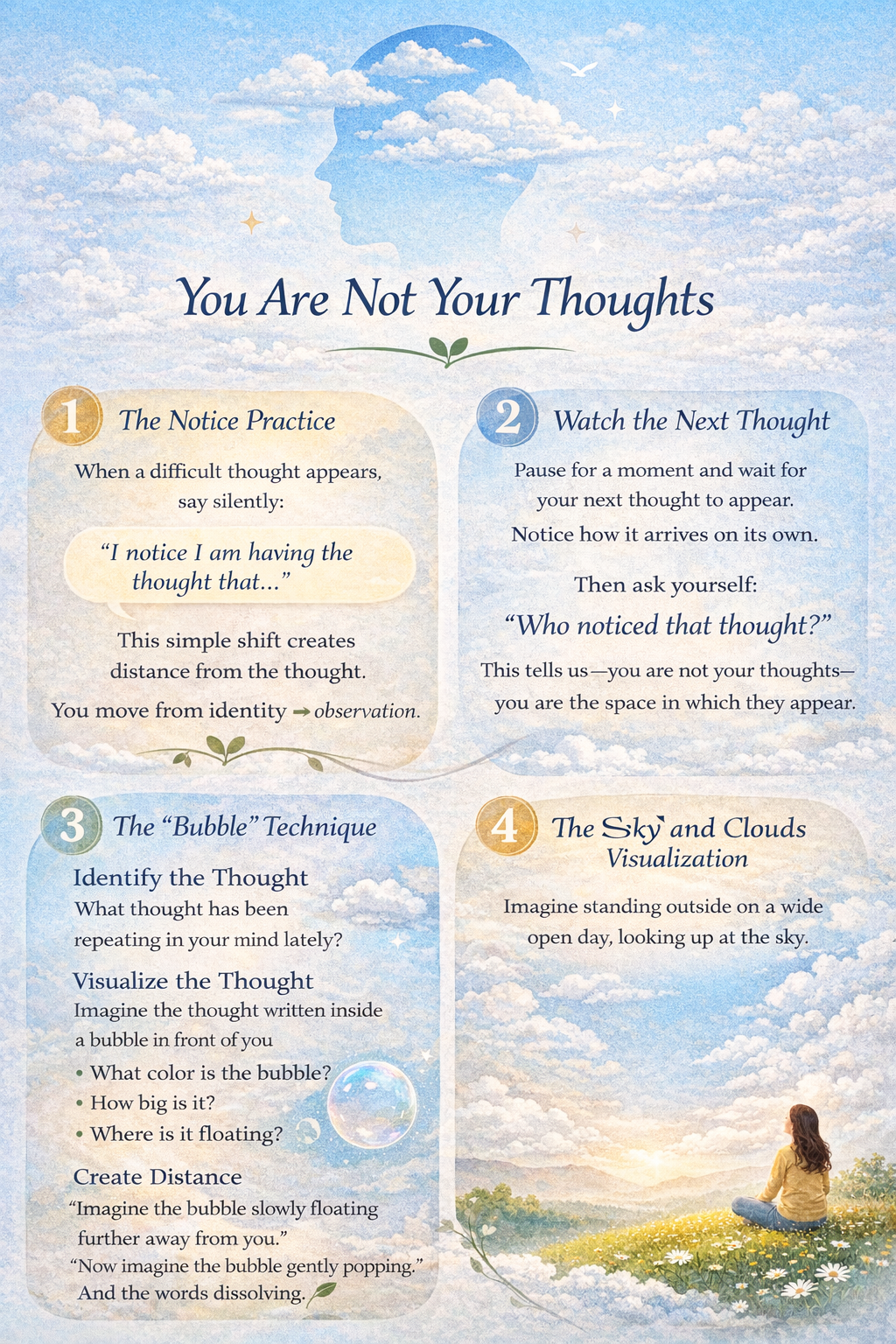
1. The Notice Practice
When a difficult thought appears, say silently:
“I notice I am having the thought that…”
Example:
“I notice I am having the thought that I might fail.”
This simple shift creates distance from the thought.
You move from identity → observation.
2. Watch the Next Thought
Pause for a moment and wait for your next thought to appear.
Notice how it arrives on its own.
Then ask yourself:
“Who noticed that thought?”
This tells us - you are not your thoughts - you are the space in which they appear. 🌱
3. The “Bubble” Technique
Identify the Thought
“What thought has been repeating in your mind lately?”
Visualize the Thought
Imagine the thought written inside a bubble in front of you
• What color is the bubble?
• How big is it?
• Where is it floating?
Create Distance
“Imagine the bubble slowly floating further away from you.”
“Now imagine the bubble gently popping.” And the words dissolving.
Install Observer Awareness
“If the thought can appear… move… and disappear…
What does that say about your relationship with it?”
Thoughts are events, not identity. 🌱
3. The Sky and Clouds Visualization
“Imagine standing outside on a wide open day, looking up at the sky.
Imagine your mind as the sky.
Thoughts are clouds passing through.
Some clouds are dark, some are light, but the sky remains open and unchanged.
You are the sky - not the clouds.
— — — 🌿 — — —— — — 🌿 — — —— — — 🌿 — — —— — — 🌿 — — —— — — 🌿 — — —— — — 🌿 — — —— — — 🌿 — — —— — — 🌿 — — ——
💛 The Joy Connection
When we stop identifying with every thought, life becomes lighter.
Instead of constantly battling the mind, we begin to observe it with curiosity.
Moments of joy naturally return when we realize we don’t have to carry every thought our mind produces.
Just like clouds drifting through the sky, thoughts can pass without disturbing the vastness of who we are. 🌱
— — — 🌿 — — —— — — 🌿 — — —— — — 🌿 — — —— — — 🌿 — — —— — — 🌿 — — —— — — 🌿 — — —— — — 🌿 — — —— — — 🌿 — — ——
🧠 NLP Insight
In Neuro-Linguistic Programming, one important principle is that **the meaning we give to our thoughts shapes our experience of reality**. Yet many of us treat every thought that appears in the mind as if it were an unquestionable truth.
NLP invites us to develop a skill called **dissociation**, which means stepping back and observing our thoughts instead of automatically identifying with them.
For example, when the mind says, “I’m not good enough,” often experiencing it as a statement about who we are, say “I am having the thought that I’m not good enough.”
This small change creates psychological distance. The thought is no longer your identity - it becomes something you can observe, question, and choose whether to believe.
From an NLP perspective, thoughts are representations created by the mind, not fixed truths.
When we learn to step into the observer position, we gain the ability to respond more consciously rather than reacting automatically.
And in that moment of awareness, we remember something important:
Thoughts are something we experience - not something we are.🌱

🧠 Neuroscience Insight
Neuroscience shows that the brain naturally produces a continuous stream of thoughts. A network called the Default Mode Network (DMN) becomes active when the mind is at rest, generating thoughts about the past, the future, and ourselves.
Many of these thoughts arise automatically, without conscious intention.
The brain also has a negativity bias, meaning it tends to focus more on potential problems or threats. This is why the mind sometimes produces worrying or self-critical thoughts even when there is no real danger.
However, when we pause and simply observe our thoughts, the prefrontal cortex - the part of the brain involved in awareness and regulation - becomes more active. This helps us respond more calmly instead of reacting automatically.
When we recognize that thoughts are simply patterns of neural activity passing through the mind, we begin to relate to them with greater curiosity and less attachment.
And in that space of awareness, it becomes easier to remember:
A thought is something the brain generates - but it does not define who we are. 🌱
— — — 🌿 — — —— — — 🌿 — — —— — — 🌿 — — —— — — 🌿 — — —— — — 🌿 — — —— — — 🌿 — — —— — — 🌿 — — —— — — 🌿 — — ——
🪞 Reflection for This Week
Before you move on with your day, take one quiet moment.
Notice a thought passing through your mind.
Maybe it is about something that happened earlier today…
or something that might happen tomorrow.
Instead of following the thought, simply observe it.
Watch it appear.
Watch it stay for a moment.
And watch it fade away.
Then gently ask yourself:
If I can observe my thoughts…
what does that say about who I really am?
In that simple moment of awareness, you may discover something beautiful:
Thoughts may come and go.
But the awareness noticing them remains steady, open, and free.
And in that awareness, a small seed of joy quietly grows. 🌱
📝 Practice for the Week
This week, experiment with observing your thoughts instead of immediately believing them.
Whenever a thought appears, pause and ask:
“Is this a fact, or is it simply a thought passing through my mind?”
Each time you notice the difference, you strengthen your ability to live from awareness rather than automatic thinking.
And in that awareness, small seeds of joy begin to grow.
This week’s seed is simple: If you can observe a thought, it cannot be who you are. 🌱
🌿 🌿 🌿 🌿 🌿 🌿 🌿 🌿 🌿 🌿 🌿 🌿 🌿 🌿 🌿 🌿 🌿 🌿 🌿 🌿 🌿 🌿 🌿 🌿 🌿 🌿 🌿 🌿 🌿 🌿 🌿 🌿 🌿 🌿 🌿 🌿 🌿 🌿 🌿 🌿 🌿
🌱 Every thought plants a seed. Choose the ones that grow into joy.
Enjoy every moment of your life, Live Joyfully :)
✨ Choose consciously. Live joyfully. Become who you’re meant to be.
Pause for a moment & Share
Sometimes it’s the smallest decisions that can change your life forever.
✨ Choose consciously. Live joyfully. Become who you’re meant to be.
©2023 All Rights Reserved