
By Meera | Oct 12, 2025 |
There’s a moment that happens after disappointment - after the email that says “no,” after the plan falls apart, after the hard conversation.
It’s the quiet moment when you decide what to do next.
Resilience isn’t loud. It doesn’t always look heroic. Often, it looks like getting out of bed when you’d rather hide. It looks like trying again. It looks like taking one small step forward when the path feels uncertain.
Resilience is not about never falling. It’s about learning how to rise - gently, steadily, and sometimes imperfectly.
This week’s seed is simple: Resilience
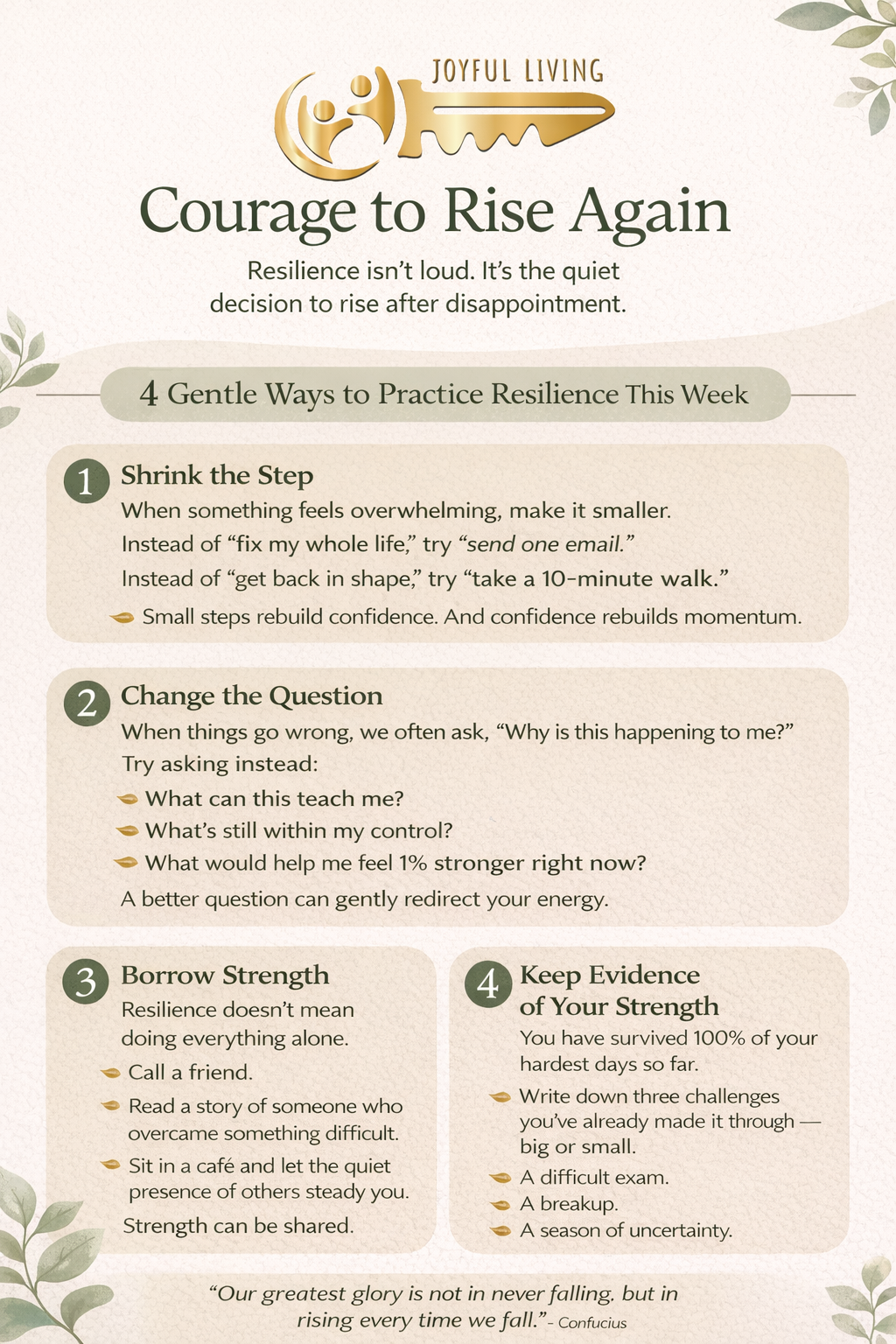
“Our greatest glory is not in never falling, but in rising every time we fall.” - Confucius

A Story
A neighbor once planted a tiny tree in her yard. That first winter was harsh - heavy winds, freezing nights.
By spring, the tree looked bent and fragile. But it wasn’t broken.
Year after year, it kept growing. Its trunk curved slightly from those early winds, but that curve made it stronger.
The bend became part of its character - not a flaw, but a testament.
We are often like that tree.
The hard seasons may shape us, but they do not have to undo us.
As Japanese novelist Haruki Murakami writes: “And once the storm is over, you won’t remember how you made it through…
But one thing is certain. When you come out of the storm, you won’t be the same person who walked in.”
Growth rarely feels comfortable. But it is often quietly transformative.
4 Gentle Ways to Practice Resilience
1. Shrink the Step
When something feels overwhelming, make it smaller.
When we feel overwhelmed, our nervous system goes into protection mode.
Big goals can feel threatening - even if they’re positive. That’s why shrinking the step works. It lowers resistance.
Instead of trying to solve everything at once, ask:
What is the smallest useful action I can take right now?
Not perfect. Not complete. Just useful.
Write one paragraph instead of finishing the report.
Organize one drawer instead of the entire room.
Walk for 10 minutes instead of committing to a full workout.
Small steps rebuild confidence. And confidence rebuilds momentum.
2. Change the Question
When things go wrong, we often ask, “Why is this happening to me?”
The questions we ask shape the stories we tell ourselves.
After disappointment, it’s natural to ask, “Why me?”
But that question often deepens helplessness.
Try asking:
What is this situation asking me to learn?
What part of this is still within my control?
What would make this 1% lighter right now?
Even a slight shift in perspective can reduce emotional intensity.
Resilience isn’t denial.
It’s the ability to pause, reframe, and respond with intention rather than reaction.
A better question can gently redirect your energy.
3. Borrow Strength
We sometimes think resilience means handling everything independently. But isolation drains strength.
Borrowing strength is wise, not weak.
You can:
Call someone who makes you feel grounded.
Read about someone who endured and grew.
Sit in a space where you feel calm - a park, a café, a temple, your balcony.
Humans regulate through connection.
Being seen and heard reduces emotional weight.
Resilience is not “I can handle this alone.”
It’s “I know where to turn when I need support.”
4. Keep Evidence of Your Strength
You have survived 100% of your hardest days so far.
Write down three challenges you’ve already made it through - big or small.
A difficult exam. A breakup. A season of uncertainty.
Resilience grows when we remember our own history of endurance.
Your mind naturally remembers failures more vividly than victories. That’s a survival bias.
But resilience grows when we consciously collect evidence of endurance.
Create a small “resilience list”:
Times you thought you wouldn’t get through - but did.
Decisions that were hard - but right.
Seasons that shaped you.
You have survived every difficult day you’ve faced so far. That is not small.
When doubt whispers, “You can’t handle this,”
your history quietly replies, “I already have.”
“You may encounter many defeats, but you must not be defeated.” - Maya Angelou

This week, try 2 gentle practice:
1. Choose one small step you’ve been avoiding and spend just 10 minutes on it.
The goal is not perfection or completion.
The goal is simply beginning.
Small steps rebuild confidence.
And confidence slowly rebuilds momentum.
At the end of the week, pause and ask yourself:
Where did I find the courage to rise again - even in a small way?
2. Write down three challenges you’ve already made it through - big or small to remind you of your strength.
Resilience is not about becoming unshakeable. It’s about becoming someone who knows they can weather the shaking.
And YOU CAN
Because resilience isn’t loud.
It grows quietly, one step at a time.
Enjoy every moment of your life, Live Joyfully :)
✨ Choose consciously. Live joyfully. Become who you’re meant to be.
Pause for a moment & Share
Sometimes it’s the smallest decisions that can change your life forever
✨ Choose consciously. Live joyfully. Become who you’re meant to be.
©2023 All Rights Reserved