
By Meera | Feb 12, 2026 |
Small reflections that grow into deeper ways of living.
Have you ever noticed how the mind sometimes keeps circling the same thought?
You replay a conversation.
You analyze a decision.
You imagine every possible outcome.
The mind searches for the perfect answer.
Yet the more we think, the more tangled the thoughts become.
This is the quiet spiral of overthinking.
But clarity rarely appears through endless analysis.
Often, clarity arrives when the mind softens, pauses, and allows space.
🌱 Seed of the Week
Clarity does not always come from thinking more - sometimes it appears when we finally allow ourselves to think less.
🌿 🌿 🌿 🌿 🌿 🌿 🌿 🌿 🌿 🌿 🌿 🌿 🌿 🌿 🌿 🌿 🌿 🌿 🌿 🌿 🌿 🌿 🌿 🌿 🌿 🌿 🌿 🌿 🌿 🌿 🌿 🌿 🌿 🌿 🌿 🌿 🌿 🌿 🌿 🌿 🌿
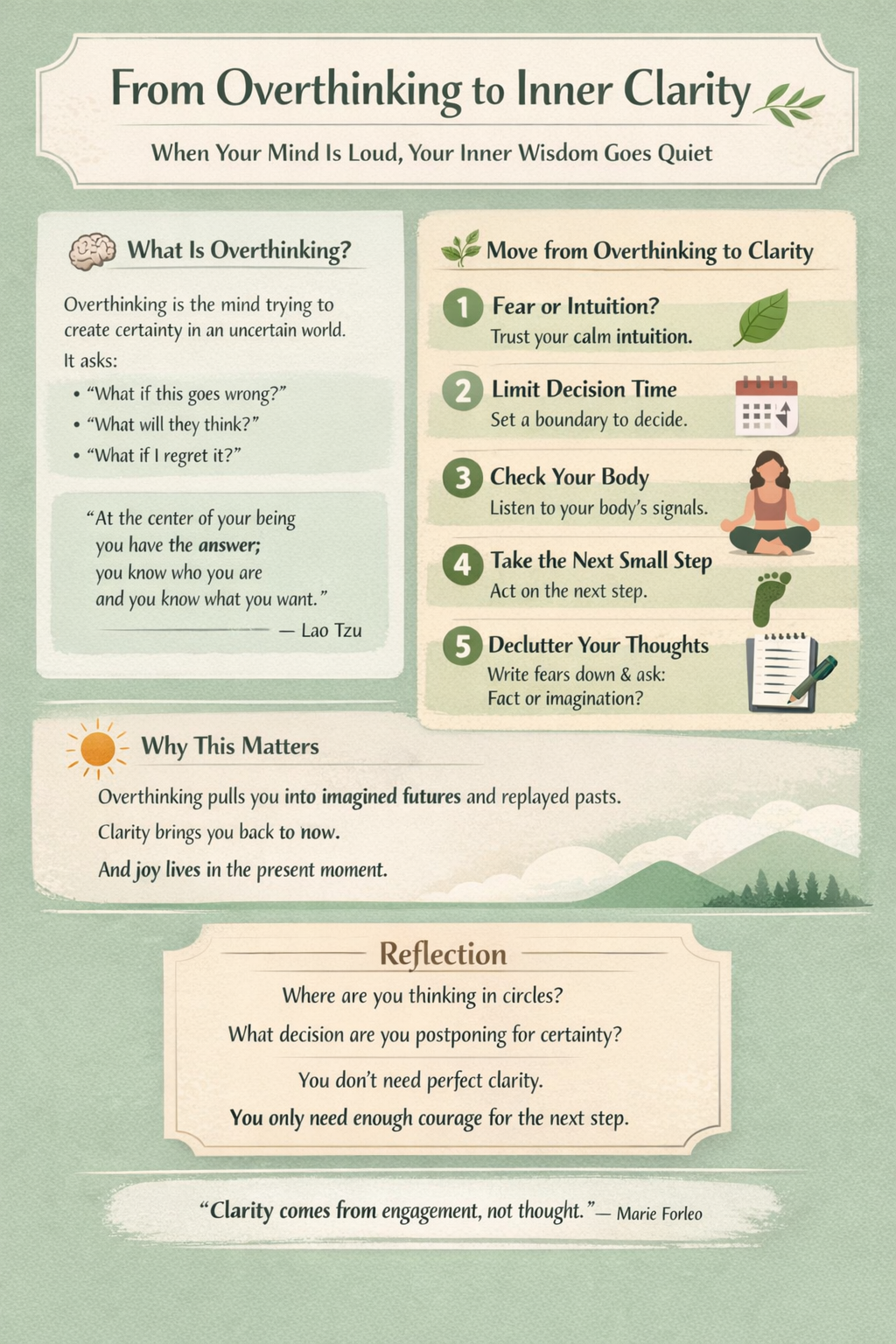
🧭 From Overthinking to Inner Clarity - When Your Mind Is Loud, Your Inner Wisdom Goes Quiet
Overthinking happens when the mind tries to control uncertainty.
The brain searches for the “perfect” solution, replaying possibilities again and again.
Have you ever replayed a conversation 20 times?
Analyzed a decision until you felt exhausted?
Imagined five possible futures - most of them negative?
That’s not intelligence. That’s overthinking.
At first, this feels productive.
But over time, too much analysis can create mental noise instead of clarity.
The mind becomes crowded with possibilities, fears, and imagined outcomes.
Ironically, the more we try to think our way to certainty, the more distant clarity may feel.
True clarity often emerges when we step back from the constant loop of thoughts.
And overthinking is rarely about the decision itself. It’s about fear of making the “wrong” one.🌱
— — — 🌿 — — —— — — 🌿 — — —— — — 🌿 — — —— — — 🌿 — — —— — — 🌿 — — —— — — 🌿 — — —— — — 🌿 — — —— — — 🌿 — — ——
📖 A Story
A traveler once arrived at a fork in the road.
Unsure which path to take, he sat down and began analyzing every possibility.
He imagined where each road might lead.
He considered what might go wrong.
He worried about choosing incorrectly.
Hours passed.
Finally, an old passerby stopped and asked why he had not moved.
The traveler replied,
“I’m trying to think carefully before deciding.”
The passerby smiled and said,
“Sometimes the road becomes clear only after you begin walking.”
The traveler stood up and took a step.
And with movement, the confusion began to fade.
🔍
Clarity often appears through action, not endless thinking.🌱
— — — 🌿 — — —— — — 🌿 — — —— — — 🌿 — — —— — — 🌿 — — —— — — 🌿 — — —— — — 🌿 — — —— — — 🌿 — — —— — — 🌿 — — ——
💡 Why Overthinking Happens
Overthinking is the mind trying to create certainty in an uncertain world.
”The brain is naturally wired to predict and prepare for the future.
When something feels uncertain, the mind tries to reduce risk by analyzing every possibility.
It asks:
“What if this goes wrong?”
“What will they think?”
“What if I regret it?”
Instead of solving the problem, the brain keeps generating new questions
But clarity doesn’t come from more thought. It comes from alignment.
As Lao Tzu said: “At the center of your being you have the answer;
you know who you are and you know what you want.
Recognizing overthinking as a protective pattern helps us respond with patience rather than frustration.
— — — 🌿 — — —— — — 🌿 — — —— — — 🌿 — — —— — — 🌿 — — —— — — 🌿 — — —— — — 🌿 — — —— — — 🌿 — — —— — — 🌿 — — ——
🎬 Movie & Series Examples
🎬 1. A Beautiful Mind – Learning What to Trust
Overthinking looks like:
Constant mental noise, trying to analyze everything.
Shift to clarity:
Nash stops engaging with every thought - he chooses what to trust.
Insight:
Clarity comes not from more thinking, but from filtering what deserves attention.
🎥 2. Sherlock (TV) – From Mental Chaos to Focus
Overthinking looks like:
Information overload, racing thoughts.
Shift to clarity:
Sherlock organizes his thoughts - focusing only on relevant clues.
Insight:
Clarity is structured thinking, not endless thinking.
🍿3. Eat Pray Love – Quieting the Mind
Overthinking looks like:
Rumination about past and future.
Shift to clarity:
Through stillness and presence, the mind begins to settle.
Insight:
Clarity often arises when the mind becomes quiet enough to listen.
🎬 4. Friends (TV) – Getting Out of Your Head
Overthinking looks like:
Looping conversations, “what ifs.”
Shift to clarity:
Talking it out, simplifying, choosing.
Insight:
Clarity grows when thoughts are expressed - not trapped inside.
“Clarity isn’t found by thinking more - it’s found when thinking finally softens.”🌱
🌍 Real-Life Situations
Overthinking appears in many everyday moments.
When making a decision:
“What if I choose the wrong option?”
After a conversation:
“Did I say the wrong thing?”
When planning the future:
“What if this doesn’t work out?”
The mind tries to protect us by analyzing every possibility.
But sometimes the most helpful step is simply to pause the mental loop.
— — — 🌿 — — —— — — 🌿 — — —— — — 🌿 — — —— — — 🌿 — — —— — — 🌿 — — —— — — 🌿 — — —— — — 🌿 — — —— — — 🌿 — — ——
💬 Quotes That Reflect This Truth
“You can’t solve a problem on the same level that it was created.” - Albert Einstein
“Too much thinking leads to paralysis by analysis.” - Robert Herjavec
“Clear thinking becomes clear action.” - William James
“Clarity comes from engagement, not thought.” - Marie Forleo
“You don’t need more time to think. You need more courage to decide.”
🛠️ How to Move From Overthinking to Clarity
You don’t silence the mind by force. You create space beneath it.
Clarity often emerges when we gently interrupt the cycle of endless analysis.
1. Notice the Thought Loop
When you find yourself repeating the same thought, pause and say:
“I’m overthinking right now.”
Ask: Is This Fear or Intuition?
Fear feels urgent, loud, and catastrophic. Intuition feels steady, simple, and calm.
1b. Practice Thought Decluttering
Write down every fear or “what if.”
Then ask: “Is this fact or imagination?”
Seeing thoughts on paper reduces their intensity.
Simply naming the pattern can begin to soften it.
2. Shift From Thinking to Sensing
Bring attention to the present moment.
Notice your breathing.
Feel your feet on the ground.
Check Your Body - Close your eyes.
Imagine Option A. Notice your body.
Imagine Option B. Notice your body.
Your nervous system often knows before your mind agrees.
Grounding the body can quiet the mind.
3a. Ask a Simpler Question
Instead of asking:
“What is the perfect decision?”
Ask: “What feels like the next small step?”
3b. Limit Decision Time
Give yourself a container. “I will decide by Friday.”
Endless analysis feeds anxiety.
Boundaries create clarity.
Clarity often arrives through progress, not perfection.
4. Take One Small Action
Take the Smallest Next Step - You don’t need the full map. Just the next step.
Even a tiny step can break the cycle of overthinking.
Action provides feedback that thinking alone cannot.
Movement often creates clarity.
— — — 🌿 — — —— — — 🌿 — — —— — — 🌿 — — —— — — 🌿 — — —— — — 🌿 — — —— — — 🌿 — — —— — — 🌿 — — —— — — 🌿 — — ——
💛 The Joy Connection
Joy often appears in moments of presence.
Overthinking steals presence. It pulls you into imagined futures or replayed pasts.
Clarity brings you back to now. And joy lives in the present moment.
When you stop trying to control every possible outcome and start trusting your ability to handle what comes,
life feels lighter. calmer, more spacious.
And in that space, joy returns.
— — — 🌿 — — —— — — 🌿 — — —— — — 🌿 — — —— — — 🌿 — — —— — — 🌿 — — —— — — 🌿 — — —— — — 🌿 — — —— — — 🌿 — — ——
🧠 NLP Insight
In Neuro-Linguistic Programming, overthinking is often linked to a pattern called “internal looping” -
when the mind repeatedly runs the same thoughts, questions, or imagined scenarios.
The brain is trying to find certainty.
But instead of producing clarity, the repeated internal dialogue strengthens the emotional intensity of the problem.
NLP suggests that the language and images we use in our minds shape our emotional experience.
For example:
If the mind repeatedly asks: “What if this goes wrong?”
the brain begins generating mental pictures of failure.
These internal representations activate stress responses and
make the situation feel larger and more threatening than it actually is.
One NLP approach to shifting this pattern is changing the internal question.
Instead of asking: “What if this fails?”
Ask: What is the next small step I can take?”
This shift redirects the brain from problem-focused thinking to solution-focused thinking.
When the language changes, the brain begins searching for actions and possibilities instead of risks.
Over time, these small shifts interrupt the cycle of overthinking and allow the mind to move toward clarity and forward movement.
Simple NLP Reframe
Overthinking question: “What if something goes wrong?”
NLP reframe: “What can I learn from trying?”

🧠 Neuroscience Insight
Overthinking often involves heightened activity in the brain’s default mode network (DMN) -
a system associated with self-referential thinking and mental simulations of the past and future.
When this network becomes overactive, the mind may repeatedly analyze scenarios,
replay conversations, or imagine potential problems.
Practices that shift attention to the present moment - such as breathing, movement, or mindful awareness -
activate other brain networks that help regulate attention and reduce mental rumination.
Through neuroplasticity, repeatedly practicing these shifts can gradually train the brain to move more easily from mental loops toward calm focus and clarity.
— — — 🌿 — — —— — — 🌿 — — —— — — 🌿 — — —— — — 🌿 — — —— — — 🌿 — — —— — — 🌿 — — —— — — 🌿 — — —— — — 🌿 — — ——
🪞 Reflection for This Week
Pause for a moment and ask yourself:
•Where are you thinking in circles?
•What decision are you postponing because you want certainty?
You don’t need perfect clarity to move forward. You only need enough courage for the next step.
Clarity grows with action.
📝 Practice for the Week
For the next seven days, notice when your mind begins looping the same thought.
When you catch the pattern, pause and take three slow breaths.
Then ask yourself:
“What is the next small step I can take?”
Instead of searching for the perfect answer, allow clarity to grow through gentle action and presence.
“Clarity comes from engagement, not thought.” - Marie Forleo
✨This week’s seed is simple: Clarity does not always come from thinking more -
sometimes it appears when we finally allow ourselves to think less and move ahead. 🌱
🌿 🌿 🌿 🌿 🌿 🌿 🌿 🌿 🌿 🌿 🌿 🌿 🌿 🌿 🌿 🌿 🌿 🌿 🌿 🌿 🌿 🌿 🌿 🌿 🌿 🌿 🌿 🌿 🌿 🌿 🌿 🌿 🌿 🌿 🌿 🌿 🌿 🌿 🌿 🌿 🌿
🌱 Every thought plants a seed. Choose the ones that grow into joy.
Enjoy every moment of your life, Live Joyfully :)
✨ Choose consciously. Live joyfully. Become who you’re meant to be.
Pause for a moment & Share
Sometimes it’s the smallest decisions that can change your life forever.
✨ Choose consciously. Live joyfully. Become who you’re meant to be.
©2023 All Rights Reserved